AESC logo

About AESC

This author has not yet filled in any details.
So far AESC has created 755 blog entries.

Inclusion in a post-COVID Workplace

Among the lessons of COVID-19 is the knowledge that human beings and our organizations can adapt more quickly and completely than we ever imagined. No one could have predicted how fast and how effectively office workers would adapt to remote work, or how nimbly business models would change. Health care, food service, education, entertainment, manufacturing and more evolved on the spot. COVID proved that the inability to adapt can be catastrophic. It also proved that we can change, if we want to. Going forward, how can C-level executives best ensure cultures of inclusion in the post-COVID workplace, and in turn, best attract and retain top talent? REFRESHER COURSE: Inclusion by the Numbers Thought leaders, executives, government entities and researchers have published, persuaded and pleaded the clear case for inclusion. Change has been slow despite the data-driven case for inclusion, but the numbers speak for themselves: INCLUSION AND THE WAR FOR TALENT In the ongoing competition for top talent, inclusive workplaces have a quantifiable advantage. July 2020 research from McKinsey found that 39% of all respondents say they have turned down or decided not to pursue a job because of a perceived lack of inclusion. Next-Gen talent is significantly more likely [...]

By |2025-10-15T21:21:23-04:00November 5, 2021|Executive Talent Magazine|Comments Off on Inclusion in a post-COVID Workplace

Security in the Hybrid Workplace

The transition to remote work in 2020 has driven technology adoption at an unprecedented pace. Online events, teleconferencing, and virtual meetings quickly became the standard. “Zoom” entered the vernacular seemingly overnight. At virtual happy hours, conversations swirled around whether Microsoft Teams or Slack was the better collaboration tool. Necessity became the mother of adoption. The threats This transition was also the mother of opportunity for cyber criminals and threat actors worldwide. The security implications for remote and hybrid work are immense, in which new vulnerabilities are met by an evolution in the threat arena. 1. Outside the Wall As the threat of COVID-19 became understood in early 2020, the first priority for organizations was business continuity: keeping employees and customers safe, shifting to remote work, deploying new collaboration tools, and building ecommerce capabilities. As vast numbers of workers left the security of their employers’ firewalls, technology leaders had to act quickly to improve endpoint security. Employees’ home networks are more vulnerable, and it is challenging to ensure that all security patches and updates are installed on employees’ home networks and devices. 2. Peak Volume Online shopping, virtual engagement tools, social media-supported food delivery and a jump in IoT (Internet of [...]

By |2025-10-15T21:21:23-04:00September 1, 2021|Executive Talent Magazine|Comments Off on Security in the Hybrid Workplace

Effective Leadership in Turbulent Times

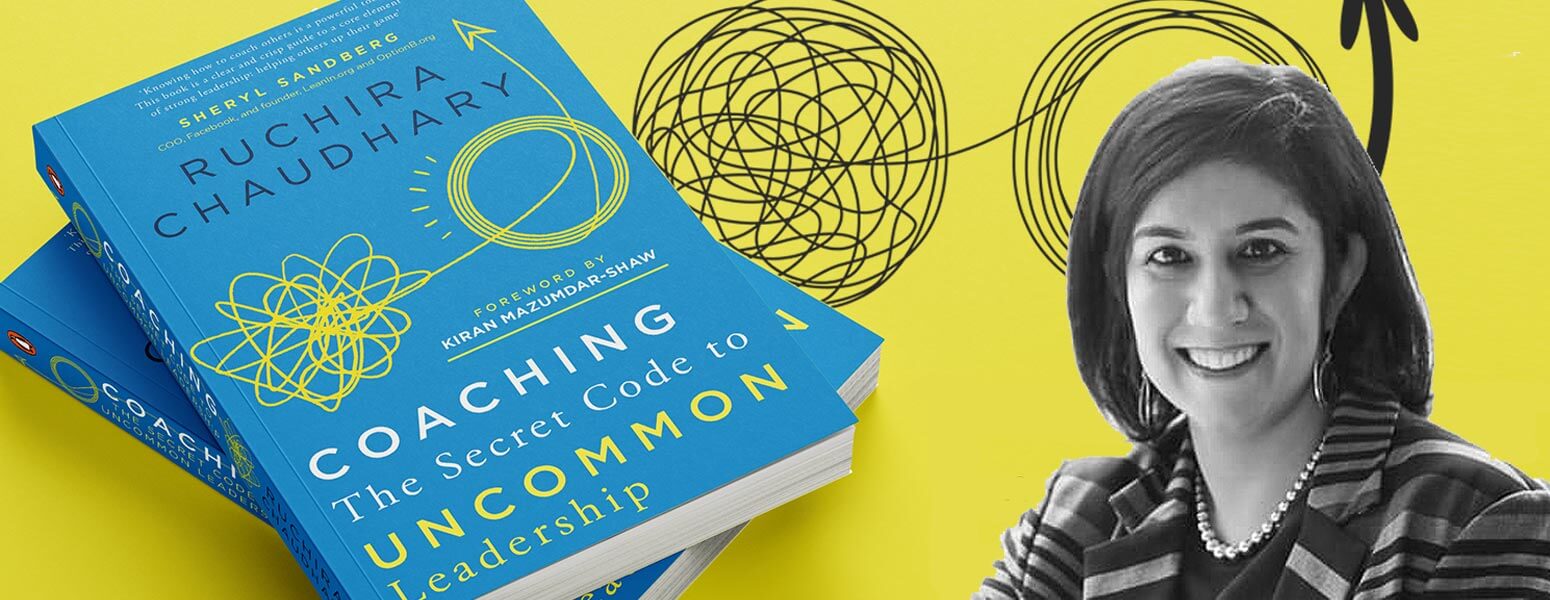
In Coaching: The Secret Code to Uncommon Leadership, Author and Leading Executive Coach Ruchira Chaudhary unpacks the critical role of leadership and coaching in turbulent times. Ruchira's new book contains valuable insights drawing on lessons from interviews with successful leaders worldwide.  Effective Leadership in Turbulent Times In June 1966, Robert F. Kennedy said in a speech in Cape Town, ‘Like it or not, we live in interesting times. They are times of danger and uncertainty; but they are also more open to the creative energy of men than any other time in history.’ You may be familiar with this apocryphal Chinese curse that sounds like a blessing or a warm wish but is used ironically to indicate a period of chaos or disorder. I cannot think of a better analogy to describe the uncertainty of mammoth proportions we face today, caused by the COVID-19 pandemic. On the work front, virtually overnight, the economic shock gave rise to a new reality that caused much stress and anxiety, leaving everyone bewildered. The work from home (WFH) phenomenon is now becoming our new normal; we may have settled into a routine of sorts, but the underlying duress, angst and the occasional panic attack is [...]

By |2025-10-15T21:21:23-04:00August 23, 2021|Executive Talent Magazine|Comments Off on Effective Leadership in Turbulent Times

Next Gen Talent in a Post-COVID World: Preparing for Future Leaders Now

“In these challenging times, it’s difficult to anticipate how customer needs will evolve and how operations may be disrupted. A business must be flexible and adaptable to stay relevant. This challenge will persist if a company is resistant to change. That’s why introducing young talent to the business is so important. Young employees can augment a company’s agility, and ensure it has the technical skills and innovation needed to succeed.” Marvin Opperman, “Businesses should be actively seeking out young talent right now.” HR Future, 9 February 2021 People and organizations will come out of the COVID-19 crisis changed, if not transformed. Next gen talent—specifically younger Millennials and older Gen Zs who grew up digital and came of age during the global financial crisis and the COVID-19 pandemic, respectively, have been shaped by this disruption in meaningful ways. C-suite executives investing in their talent pipeline and preparing to recruit and retain young, high-potential candidates would do well to consider the social and professional impact of the pandemic on these future leaders. Next Gen Snapshot Multiple researchers on generational ‘types’ indicate that Millennials, born from 1980 to 1995, tend to be willing to compromise, have learned to be self-sufficient, and want to [...]

By |2025-10-15T21:21:23-04:00August 8, 2021|Executive Talent Magazine|Comments Off on Next Gen Talent in a Post-COVID World: Preparing for Future Leaders Now

Communicating in the New Normal: Digital Body Language with Erica Dhawan

“Digital tools that got little traction for years are now business requirements, not only for productivity, but also for client engagement, business development, even social connection and celebration. The question we have to ask ourselves is no longer how will we adapt to our new normal, but more importantly, how will we create a better normal?” Erica Dhawan, AESC Virtual Conference. May 12, 2021 Erica Dhawan is an award-winning speaker, author and student of innovation and collaboration who spoke about digital body language, why it matters and how to use it to master sales and engagement at the 2021 AESC Virtual Conference, “Thriving in the Next Normal.” A New Language Barrier In a recent study of over 3000 office workers Dhawan found that the average employee is wasting up to four hours per week on poor, unclear or confusing digital communication. If roughly three-fourths of face-to-face communication is nonverbal body language, what are we missing when we are no longer communicating face to face? When we are engaging with people on screen, Dhawan said, “We can't just sense if someone's on the verge of tears or really excited; we can't read the ‘lean in,’ in a sales conversation with a [...]

By |2025-10-15T21:21:23-04:00July 15, 2021|Executive Talent Magazine|Comments Off on Communicating in the New Normal: Digital Body Language with Erica Dhawan

ESG in Turbulent Times: Difficult Decisions in Difficult Moments

ESG is more than a guideline for the good times, when companies can afford to be benevolent. Rather, it is a roadmap to sustainable value creation. “Beyond the crisis horizon, more evidence is emerging that companies that follow more narrowly defined ESG standards, on average, outperform the market,” according to the World Economic Forum. (September 2020) Yet, as world economies emerge from the overlapping crises of climate events, social unrest and a global pandemic, organizations that adhere to the ESG ethos have had their commitments tested. HARD CHOICES What do boards see as their responsibility in times of intense challenge? Their first order of business is making sure there is a business. Mpho Nkeli is Director at Search Partners International/AltoPartners in South Africa. “The responsibility of boards during a pandemic or crisis of this nature is multifold. Number one is to make sure that the business survives, if the business doesn't survive, everything else is secondary. When companies become cash strapped, the question is, what do you prioritize?” “This is not just about your environmental footprint or how green your operations are. It is about fundamentally striving to do the right thing by all stakeholders. It is about how you [...]

By |2025-10-15T21:21:24-04:00July 6, 2021|Executive Talent Magazine|Comments Off on ESG in Turbulent Times: Difficult Decisions in Difficult Moments

Shifting to Stakeholder Capitalism: Beyond Virtue Signaling to Viable Impact

"What kind of capitalism do we want? That may be the defining question of our era. If we want to sustain our economic system for future generations, we must answer it correctly.” -Klaus Schwab, Founder and Executive Chairman, World Economic Forum We are entering the era of stakeholder capitalism. What do we mean by that? Lutfey Siddiqi, Managing Director at the CFA Institute and a visiting professor in practice at the London School of Economics describes the shift in corporate leadership “from an allegiance to a single stakeholder—shareholders—to a multi-stakeholder approach,” which requires corporations “to be mindful of their impact, positive and negative, on the environment, on employees, on the societies that they operate in." “All of those things need to be considered,” Siddiqi says. “That is the ethos of stakeholder capitalism.” The concept of corporations taking their responsibilities beyond financial measures such as quarterly returns and profitable growth may be a bit of a pendulum swing. According to The New York Times “Deal Book” columnist Andrew Ross Sorkin, through the mid-20th century “corporations, for the most part, were run for all stakeholders. It was a time defined by organized labor, corporate pension programs, gold-watch retirements and charitable gifts from [...]

By |2026-01-07T11:57:53-05:00June 17, 2021|Executive Talent Magazine|Comments Off on Shifting to Stakeholder Capitalism: Beyond Virtue Signaling to Viable Impact

TSR: The Intersection of Technology & Corporate Social Responsibility

Digital technologies are reshaping how humans live and work, and the impact on everything from individuals to economies is immense and growing. Mitigating the disruptive impact of tech and being deliberate about its constructive application is at the heart of Technological Social Responsibility. PUTTING THE TECH REVOLUTION IN CONTEXT Sometime in the 6th century BC Heraclitus wrote, “The only constant in life is change.” Lest we think the current tech revolution is unprecedented, Eric Hazan, Senior Partner at McKinsey & Company, reminds us that we have been here before. “We have experienced three industrial revolutions, even before this one. And the impact of technology on society and the economy is similar each time. It’s destabilizing. Some businesses die, some new businesses are created, and overall the equation is rather positive for economic growth and society also. But the transition is painful. That’s what has happened over the past 250 years."  Digital transformation itself, Hazan explains, has three waves to it. “The first wave, which is occurring from the middle 1990s until now, is digital technology, which includes telecommunications and the internet. The second wave is artificial intelligence, which has been present in a commercial way for the past five to [...]

By |2025-10-15T21:21:24-04:00June 3, 2021|Executive Talent Magazine|Comments Off on TSR: The Intersection of Technology & Corporate Social Responsibility

Leveraging Inclusion to Win

A Conversation with John Amaechi John Amaechi, OBE is founder of Amaechi Performance Systems, an organizational psychologist, author, Board Director, and thought leader. AESC spoke with him about the relationship between diversity and inclusion and organizational competitiveness. Amaechi is very competitive. “I’m just really interested in winning,” he says. “And diversity and inclusion is one of the elements of that success.” Defying Definition How we look at and define “diverse” is often incomplete, and Amaechi argues that we need to be sure that we are thinking of race and gender inclusively. “It’s amazing when you talk about race, people often imagine that that’s about Black men. When you talk about gender, people often imagine that that’s about white women, and specifically white professional women.” Amaechi adds, “We sometimes act as is if women who don’t have jobs don’t count. That’s not what I think, but it is how we behave.” For Amaechi, absolutely every form of diversity needs to be part of the conversation. “Disability is one of those areas of inclusion that is neither sexy enough nor interesting enough for people to want to have a discussion about. It’s also just dangerous enough so that people with disabilities often [...]

By |2025-10-15T21:21:24-04:00May 24, 2021|Executive Talent Magazine|Comments Off on Leveraging Inclusion to Win

4 Components of Effective Leadership

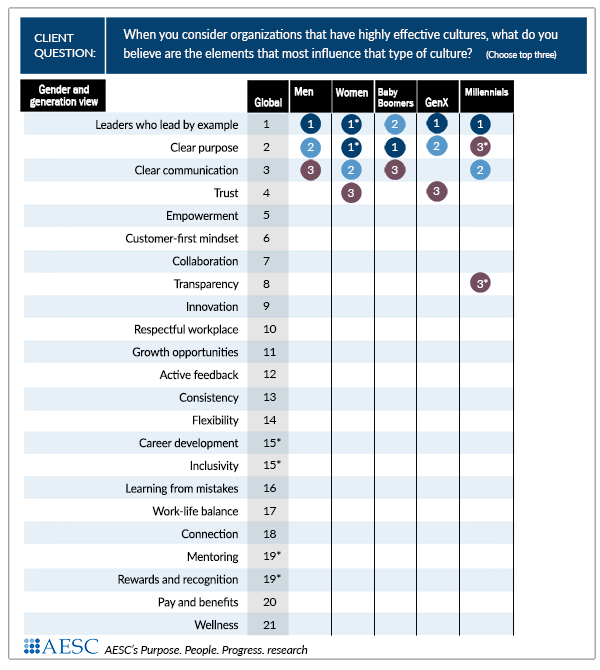
In the search for top talent, employee experience and workplace culture are as important as benefits packages and retirement contributions. What is the main contributing factor to this coveted workplace culture? Effective leadership. Clients understand that leadership and culture are inextricably linked. In our report Purpose. People. Progress., nearly 300 C-level business leaders across the globe cite, ‘leaders who lead by example,’ ‘clear purpose,’ ‘clear communication,’ and ‘trust’ as key elements that influence highly effective workplace cultures. These four elements, when strengthened, build effective leadership skills. And, once effective leadership is established, the coveted workplace culture that top talent is looking for will follow.  Now more than ever, effective leadership is crucial. LEAD BY EXAMPLE with CLEAR COMMUNICATION and PURPOSE Talent is looking for authenticity in leadership. An authentic leader delivers on the promises they make and communicates in a clear direct way. Simon Wan, Chair and Chief Executive, Cornerstone International Group, says authentic leadership “can be developed with a careful structuring of helping the leader to be self-reflective on his own self and the commitments and the visions and the value of the company. Because if the person is really authentic and truthful to his own meaning and purpose [...]

By |2025-10-15T21:21:24-04:00April 30, 2021|Blog|Comments Off on 4 Components of Effective Leadership
Go to Top